Animal Rahat Update
March 2012
I hope you are well and that you are ready for the latest news from Animal Rahat, where staff members have been working nonstop. Thanks to your support, Animal Rahat activists were able to improve the lives of many wonderful animals in the past month. As you read my notes on everything from "horn rasping" to broken-down donkey colts, I hope you'll be pleased with the vital role that you have played in it all.
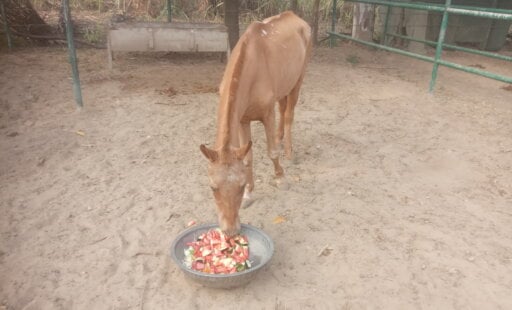
This beautiful 6-month-old donkey colt is Raghu. The Animal Rahat team responded to a call from the village of Miraj, where someone had spotted an abandoned donkey suffering from a wound on his left hind leg. Animal Rahat's veterinarians suspect that this little fellow was either badly abused by his owner or hit on the busy streets of Miraj. His nostrils had been slit open with a knife because of the mistaken belief that this allows more air into the donkey's lungs, enabling him to work harder. The team treated the wound and took him to Animal Rahat's sanctuary, Simone's Place, where he is recovering nicely. Raghu will be a permanent part of the Animal Rahat family and will never again have to fend for himself on the streets.
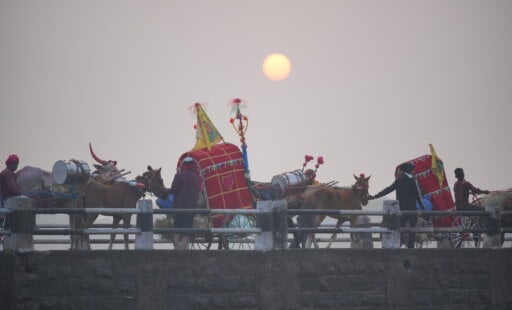
Last month, Animal Rahat staffers had to deal with the Siddheshwar Fair, a weeklong cultural festival. Because thousands of people travel to the event on bullock carts, Animal Rahat made arrangements to carry out extensive educational outreach to them as well as offer immediate medical intervention for bullocks in distress. The team gave emergency treatment to a whopping 162 bullocks—treating everything from exhaustion and dehydration to wounds and foot-and-mouth disease.
One of Animal Rahat's biggest successes was marshalling the local police to help stop abuse—especially the practice of "horn rasping." This is a procedure in which owners have a few layers of their bullocks' horns shaved off to make the animal appear younger and therefore fetch a better price from potential buyers. It's terribly dangerous for the bullocks because it can expose the nerves inside the horn (think of someone shaving off a layer of your fingernail).
Activists stopped a total of 29 bullock owners from engaging in this practice and got horn-rasping equipment confiscated from seven horn raspers. Animal Rahat staffers met with these men, warned them that horn rasping was illegal, and sent them away from the fair.
Animal Rahat's other successful educational outreach methods included street theater, highly visible signs with important animal welfare messages, and the screening of Tingya, a movie about a bullock owner who adopts a more compassionate attitude toward his bullock, thanks to his son's love for the animal.
I have both good news and bad news to report regarding Ram Prasad and Gajraj, the lonely temple elephants whose lives Animal Rahat staffers work hard to improve. The terrible news is that because the mahouts (elephant keepers) would not allow another vaccination, Gajraj went into "musth"—the turbulent hormonal cycle in which secretions emit from a male elephant's temporal glands (you can see this on the side of his face in the photo) and he becomes extremely aggressive in his desperation to mate. As you can see, he is chained so tightly by all four legs that he can't move an inch, and he is kept this way for the entire musth cycle, which can last for a couple of months or more.
Animal Rahat vets could not approach Gajraj but managed to ease his distress a little by giving him a refreshing shower and a treat of jaggery (sugar and molasses), which he eagerly ate.
The good news is that when the veterinarians met with the local rani (queen), who is Gajraj's official owner, she said that she is seriously considering constructing more humane housing, which Animal Rahat has been urging her to do for more than a year. This is a small step but a breakthrough nonetheless.
Ram Prasad is out of musth, and this time, thanks to the vaccination program, the cycle was shorter and lower in intensity than usual. The abscess on his flank had shrunk noticeably, and the mahouts seem to be following the caretaking recommendations given to them by Animal Rahat. I can't tell you how much better Ram Prasad's living conditions are compared to when Animal Rahat vets first began treating him. The ultimate goal with both elephants is to get them out of these chains for good and into enclosures in which they can walk unfettered, but this is a long process hindered by greed, traditional approaches, and insensitivity to the suffering of the elephants.
At Simone's Place, the staff has been increasing the grooming time for the bullocks, and the animals love it! Usually, the Animal Rahat staffers use food to lure a bullock to follow them. But a bullock named Kakde would have none of it. Poor Kakde lost his right horn in an accident and is understandably wary of people, often charging them if they come too close. One day, Dr. Manilal tried to lure Kakde with several delicious treats, but Kakde kept his distance.
Dr. Manilal gave up and began grooming a bullock named Rame, who was enjoying the session and leaning into Dr. Manilal to urge him to continue. Kakde watched intently and slowly came closer and closer. Dr. Manilal reached out and gently touched the brush to Kakde's forehead. To everyone's surprise, the animal didn't move. Within minutes, Dr. Manilal was brushing Kakde all over, and the bullock was relaxing and even turning his head and body to give Dr. Manilal access to all the hard-to-reach spots!
Now that the bullocks are used to grooming sessions, the vets often don't even have to use treats to take the bullocks where they want them—they just hold out a brush, and the bullocks come right over.
Lastly, I have happy endings to share with you regarding two wildlife rescues. You may recall that several months ago, Animal Rahat rescued a baby monkey who had fallen from a utility pole and had badly injured one of her eyes. Well, I'm pleased to tell you that her rehabilitation has been a success and that she was recently released back into the forest, where she has been accepted into a resident group of monkeys. And do you remember the hyena who had fallen down a well? He is also enjoying his second chance at life, having been released after recovering under the care of wildlife rehabilitators.

|